Background
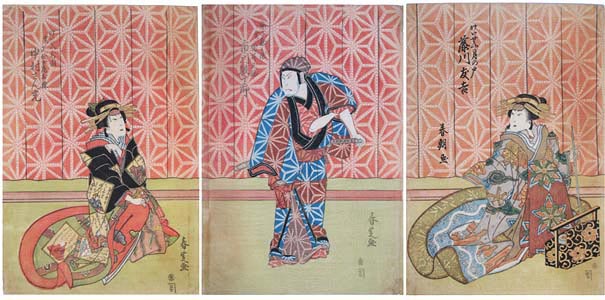
Keisei hyakumangoku (A million lands, a courtesan play, 傾城百万國) appears to be an adaptation of Ehon gappô ga tsuji (An illustrated picture-book of the crossroads of Gappô, 絵本合法衢), a masterpiece by Tsuruya Nanboku IV premiering in 1810. The story was an outstanding revenge play (adauchi mono) about the Taga clan in which good ultimately triumphs over evil, but only after complex events unfold involving mistaken identities and numerous murders.
Characters in disguise were yet another form of mitate, as here with Kanoko Kanbei (actually Torii Matasuke) and keisei Mangoku (actually Matasuke's wife Ochô). In kabuki the revelation of true identiies was sometimes accompanied by an actor delivering a speech beginning with jitsu wa ("in reality").
The artist signing Shunchô was one of Shunshi's pupils.
Design
Gatôken Shunshi (画登軒春芝) was a student of Shunkôsai Hokushû and the apparent leader of a subgroup of followers that included at least two other artists signing with the name "Shunshi" — Gakôken Shunshi (画好軒春枝 act. c. 1824-29) and Shunshi (春始 act. c. 1830s), who used different ideograms for "shi."
The actors pose before a large screen with a dotted hemp-leaf (asanoha kanoko) pattern made using the shaped-resist dyeing technique called shibori. Matasuke's robes also feature the same decoration. Tsukinoto holds an exceptionally long and expensive metal pipe (kiseru) while seated near a smoking tray (tobako bon) with metal fittings and gold lacquer decoration. (Tobacco trays served as containers for pipes, tobacco containers (tobako-ire) for shredded tobacco (kizami), ash receptacles
(hai-otoshi), and miniature ceramic charcoal braziers (hi'ire) to light pipes before matches were available.) Ochô's robes are patterned with poem cards depicting famous poets and their verses.
References: IKBYS-II, no. 214; KNP-6, p. 124; IKB-I, no. 1-437; NKE, p. 409


 Return to